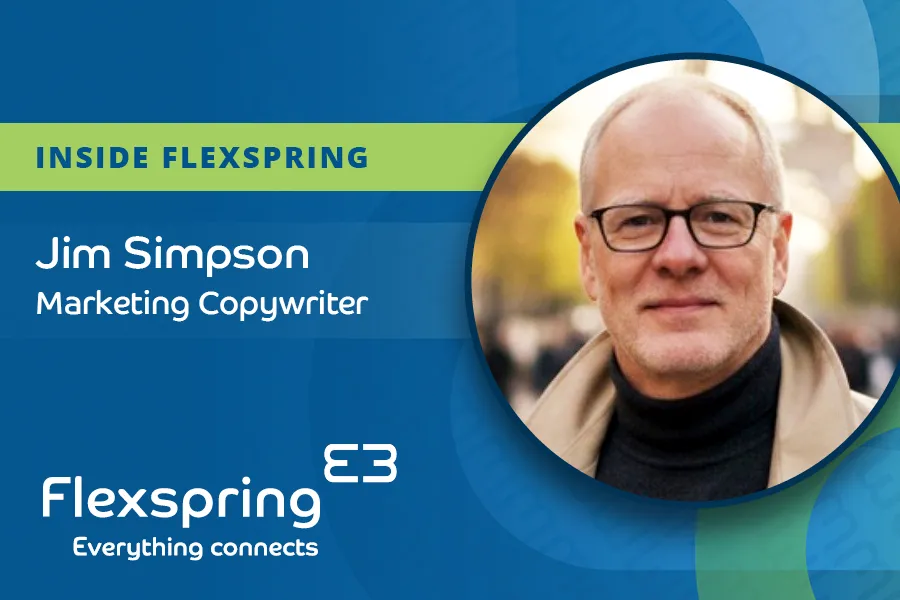
Jim Simpson has been a writer since the 6th grade. Professionally, it came a bit later — newspapers, magazines, freelance music journalism, eCommerce content, plus published fiction and poetry on his own time. Then came HR data integration, and a whole new kind of challenge.
“Writing about HR data integration, data connectors, APIs, and HR platforms is the most difficult writing I’ve ever undertaken. It’s a challenge, to be sure, but I love challenging myself.”
Jim left Flexspring for a stretch to write for a large corporation in an entirely different industry. He didn’t stay away long. What pulled him back was the thing he hadn’t expected to miss: a niche, and a small company punching well above its weight.
Today he writes from the “Creattic” — a slant-ceilinged upstairs room in Grayson, Georgia, that he shares with his wife’s painting studio — hunting the human story behind every integration. “Behind every integration, there’s a person or a team dealing with a problem,” he says. “I try to put myself in their place.”
“I missed the Flexspring vibe: a small but mighty company doing big things despite competing with much larger organizations. Bigger isn’t always better.” — Jim Simpson, Marketing Copywriter
Q & A
What do you do at Flexspring — how would you explain your job at a family dinner?
My goal is to write engaging copy that grabs the reader from the beginning so they’ll want to keep reading. Considering our industry, this isn’t easy to do, but it’s also my approach to explaining my job when family and friends ask about it. I put them into the picture: Have you ever had a paycheck delayed because of some incorrect data, or because someone forgot to send an update? Worse yet, has your check ever been short? Then I tell them this is often caused by unintentional human error when transferring information from one app to another. This usually paints a clearer image of the importance of data connectors that make apps “talk” to each other – data is entered once, and the connectors our experts build do the rest automatically, and that’s basically what I write about.
What were you doing before this? What is your background?
Before joining Flexspring, I was an eCommerce content writer and freelance writer. I’ve also worked as a production graphic artist, a newspaper staff writer and editor, a magazine writer, and a freelance music journalist.
What was the first thing that made you think, “Okay, I’m going to like this place”?
From the initial interview with James Connor, I knew I wanted this job. He and I seemed to connect quickly – we’re both writers, we have NYC and marketing in common (my father and grandfather were both in the advertising business in NYC), and my home office walls are the same shade of green James had in his Manhattan office. Small world! The ability to work from home was also a big draw.
You left Flexspring for a while and then came back. What took you away, and what brought you back?
I left briefly to write for a big corporation in a completely different industry, but I missed the Flexspring vibe: a small but mighty company doing big things despite competing with much larger organizations – bigger isn’t always better. A co-worker at the time mentioned the company’s new ERP software, and I got really excited. “I know what that is – I used to write about that!” I missed this niche style of writing, and that surprised me. Also, I saw a LinkedIn video of Yan talking into the camera as he strode through an airport on his way to meet with a client. There’s something very inspiring about him as an entrepreneur.
Where are you based, and what does your workday look like from there?
I’m in Grayson, Georgia, about 30 miles east of Atlanta. I have a “corner office” (with a window!) in a spare room upstairs in my house, which is in the Cape Cod style, so the ceilings in my office are slanted, giving it an attic feel. My wife is a visual artist and has her studio art table and canvases in the opposite corner from where I work. It’s a creative attic, so we jammed those words together and refer to it as the “Creattic.”
Although I could work in my PJs, I dress for work like I’m going to an office, albeit a casual office because in the summer I always wear shorts! I keep detailed “to-do” lists and notes to track my projects, ideas for articles, and research for upcoming case studies. When I’m drafting a piece, I often print it and then walk around the office or step outside to read it aloud to make sure the writing flows naturally. This process catches any awkward transitions or structure.
Which parts of your work don’t feel like work?
I almost always look forward to Marketing/SEO team meetings because they’re a chance for us to connect and bounce ideas off each other, share successes, talk about the latest marketing/SEO news, and plan campaigns. There’s always something new to learn, and these meetings help keep me motivated and engaged. We’re in a very competitive business, and it’s rewarding to see that our work is making a difference, year after year.
What’s the hardest part of writing about what we do?
I’ve been a writer since the 6th grade, but only professionally many years later, of course! Writing about HR data integration, data connectors, APIs, and HR platforms in general is the most difficult writing I’ve ever undertaken. It’s a challenge, to be sure, but I love challenging myself. As a fiction writer and journalist, I’ve always focused on tracking down good stories. Everyone has a story, and to uncover them you need to be curious, ask the right questions, follow up on the answers, and dig for facts. I’ve brought those skills to Flexspring and use them for every case study, article, and LinkedIn post to find the spark that ignites each integration project. Behind every integration, there’s a person or a team dealing with a problem, usually tedious manual tasks. I try to put myself in their place to understand their struggles and discover how our consultants and project managers have made their lives easier – at least their work lives!
What’s something about your work you could talk about for an hour?
Here’s a true story as an example. On vacation in Northern California two years ago, my wife and I went to a restaurant for lunch, and I noticed our server using her iPhone to take our order. When I asked her about it, she smiled and said it was a new system that she loved because it was much more streamlined than their previous clunky system. When I asked if the POS system synced with their payroll platform and time-tracking system, she paused with a very odd look on her face. “Are you in the business or something?” she asked. I told her what I did for a living and proceeded to conduct a short case study. While she was really excited to talk about it – and so was I – my wife reminded me that we were on vacation and that I should stop talking about work.
Who here has taught you the most, and what did they teach you?
James Connor has taught me to be a more focused writer, to keep the HR data integration audience in mind with each piece I write, and to constantly strive to be a more careful editor of my own writing.
What’s the next thing you want to get better at?
Driving at night, but I don’t think that will ever happen.
What are you into that has nothing to do with work?
I’m an avid runner, averaging 20-25 miles per week. It’s an awesome way to clear my head in the morning before I start work, but I often find myself thinking about a Flexspring article I’m stuck on, and fortunately I can usually get “unstuck” while out on the road. The Atlanta area has a thriving running community, and I’m glad to be part of it.
I’m also a published fiction writer and poet.
What’s the best thing you’ve read or watched lately?
I read The Count of Monte Cristo by Alexandre Dumas recently. It was daunting at 1,300 pages, but it moved along quickly, and was like nothing I’d ever read. I also just finished Circe by Madeline Miller, and I’ve been re-reading novels by Elizabeth Strout and Paul Auster. Also, I’ve been reading a collection of Gay Talese’s classic New York journalism, A Town Without Time.
If someone joined your team tomorrow, what’s the first thing you’d tell them?
Don’t be afraid to ask questions. Flexers are often super busy, but will always take time to help out when you’re unsure or confused about an integration or technical issue.
What advice would you give someone starting out in your field today?
Embrace technology, listen, ask questions, be curious!
____________
Check out our current job openings
Work from home. Flexible hours. Discover career opportunities that let you use your coding and technical consulting skills to solve the biggest challenge with SaaS apps: data integration.