Article Summary: Disconnected HR systems quietly drain time, create payroll errors, and make accurate reporting harder. This article shows how HR software integrations fix those gaps, reduce manual work, improve accuracy, and give HR and payroll teams a smoother way to work.
HR Software Integrations Key Takeaways
- HR software integrations can quietly determine whether your HR team spends the week moving data by hand or running smoother, faster workflows across payroll, onboarding, and benefits.
- One missed employee update can reveal why HR software integrations matter so much, especially when bad data triggers payroll errors, reporting issues, and hours of cleanup across disconnected systems.
- Flexspring makes HR software integrations more practical by combining prebuilt data connectors, custom mapping, and managed services around the way HR and payroll teams actually work.
- Real-world case studies show how HR software integrations save time, reduce errors, and make onboarding a smooth experience for hiring managers and new employees.
- Smart HR software integrations make sure the right data goes to the right place at the right time, without creating extra cleanup for your team.
- HR software integrations improve payroll accuracy by making sure clean, up-to-date employee data reaches payroll before errors turn into corrections, delays, and frustrated employees.
Want to know the full story? Read on.
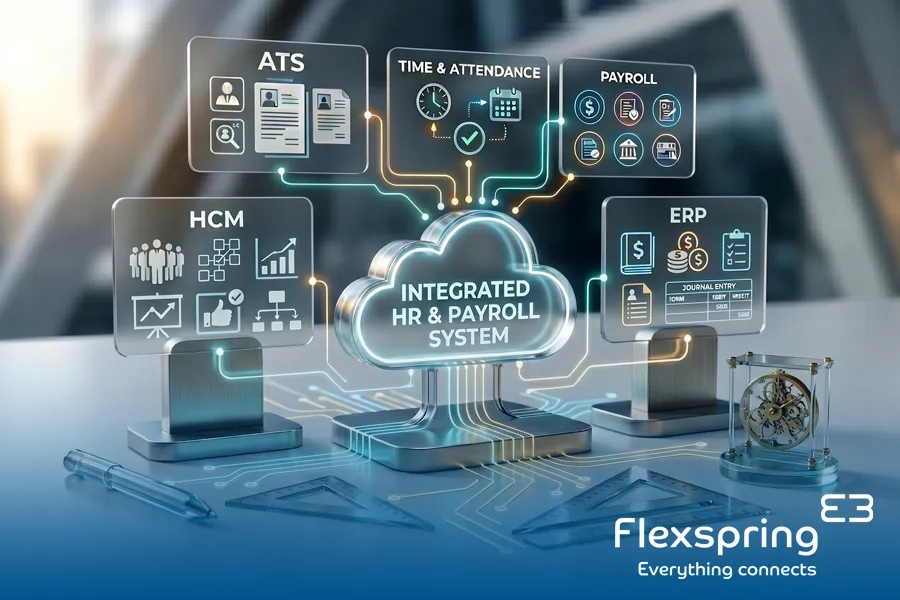
Your HR tech stack likely grew one tool at a time. An applicant tracking system (ATS) from one vendor, a human resources information system (HRIS) from another, payroll from a third, plus separate tools for onboarding, time, and benefits. Each tool solves a specific problem, but together they create a bigger one: data lands in one system and never reaches the others cleanly. New hires sit in the ATS instead of payroll, address changes are updated in HRIS but not in benefits, and payroll scrambles every cycle to fix missing or conflicting records.
An industry study found 85% of companies use two or more HR apps from different vendors. If this sounds familiar, you know disconnected systems create avoidable errors, delays, and frustration, pushing HR into manual entry, spreadsheet uploads, and late-night fixes. HR software integrations replace that grind with fast, accurate, automated data flow, so employee data moves once and stays consistent everywhere.
Smart HR teams want one version of the truth across all HR and payroll systems. To reach it, you need a clear picture of how HR software integration works in the real world.
HR Software Integration Explained
HR software integration connects the systems you already rely on and gives them a structured way to talk to each other. Think about one employee. Their profile starts in recruiting, moves into onboarding, becomes the core HR record in your HRIS, then feeds payroll, time, and benefits. Without HR system integration, each application keeps its own version of that person. Every hire, promotion, or address change triggers a chain of manual updates and “Who owns this field?” debates.
With HR software integrations in place, that same data moves on its own, under your control. Typical flows include:
- New-hire data moving from ATS to onboarding and your HRIS.
- Job and position data staying aligned between HRIS and downstream systems.
- Payroll-related fields, such as compensation, hours, and employment status cleanly moving from HRIS to payroll.
- Terminations cascading to time, benefits, and payroll in a predictable sequence.
In most organizations, HRIS integration sits at the center of this picture. The HRIS typically acts as the system of record for employee data, while other tools either feed new information into it or consume updates from it. Good HR data integration does more than map fields. It defines ownership (which system wins when values conflict), timing (when data moves), exception handling (what happens when something fails), and logging (who changed what and when). Every update follows a clear pattern instead of a one-off decision.
Once you put real employee data under the microscope, the limits of “out-of-the-box” integration promises show up fast. Different data models, custom fields, and local business rules quickly break generic connectors. HR software alone can’t smooth those differences. You need an integration strategy that reflects how your HR and payroll teams actually work, not just how a product demo looks.
Why HR Software Depends on Integrations
You hear it in almost every sales cycle: “Our system integrates easily.” Then implementation starts, and the story changes. Unfortunately, each HR system structures data differently. Field names and data syntax vary from app to app. For example, firstName to Legal First Name and SSN to National_ID_Data don’t match without mapping and sometimes data transformation. With no HR data standardization, your team spends hours translating and cleaning data by hand.
Strong integrations matter because HR data quality sits underneath almost everything you manage. Payroll feels it first. When data lacks consistency or updates, pay runs slip, adjustments stack up, and employee trust takes a hit. HR software integrations that enforce validation and transformation rules before data reaches payroll cut down on errors, rework, and escalations in a very visible way.
Compliance and audit requirements add another layer of pressure. Employers must keep accurate records for key employee events, including hiring, job changes, payroll, leaves, and terminations. Auditors may also need clear evidence of how those processes work, who approved changes, and when updates occurred. That level of traceability works best when HR data stays standardized, reliable, and easy to follow across systems. A solid HR data integration strategy, with explicit rules for updates and terminations, supports audit readiness and gives your team confidence walking into any review.
Reporting and analytics teams deal with the same issue every day. Leaders ask for accurate headcount, turnover, and compensation data across regions, entities, and business units. Without structured HR data, every dashboard becomes a custom project, and every new question triggers another data-cleansing exercise. HR software only delivers real value when clean, consistent data actually flows through it.
Once you see how much depends on that foundation, it makes sense that many HR and payroll leaders look for a partner whose core business focuses exclusively on HR software integrations, not another application vendor with a generic “integration” platform.
Flexspring’s Expertise in HR Software Integrations
Flexspring focuses solely on HR data integration for HR departments and HR software companies. HR data integration is the focus, not a side offering, so you work with a partner who lives in HR and payroll data every day.
That focus shows up in how projects run. Flexspring consultants handle the custom data mapping that fits each HR system integration with your unique workflows. You can also tap into Flexspring’s prebuilt connectors for leading HR apps with essential fields for the most common use cases. You get speed and cost savings from proven integrations, plus custom-tailored work to match your unique needs.
Flexspring offers several integration options:
- Prebuilt integrations and connectors speed up common use cases such as ATS to HRIS, HRIS to payroll, and onboarding to HRIS. Turnkey templates give you proven mappings and workflows, so you avoid starting from scratch.
- Custom HR software integrations handle complex business rules and custom data fields. Flexspring builds new connectors as needed and often already knows at least one side of the integration because of previous work with that app.
- Fully managed integration services cover monitoring, maintenance, and updates as vendors change APIs or data models. Your internal IT resources stay focused on other priorities while Flexspring keeps your HR software integrations healthy.
Technical work alone never clears all your HR integration headaches, so Flexspring also works on your processes. Consultants partner with you to decide which system owns each data element, how approvals move, and what should happen when something fails or falls outside the rules. That blend of technical skill and HR process expertise gives each integration a better chance of success and sets a solid base for future changes.
With the right partner in place, you stop guessing where to start. You can rank your integration projects by impact, focus on the ones that reduce the most manual work for HR and payroll, and build out your roadmap from there.
High-Value Use Cases for HR Software Integrations
Not every integration carries the same weight. A smart strategy focuses first on use cases that remove the most manual work and risk.
New-hire integrations connect your ATS, onboarding, and HRIS so a single “hired” click kicks off everything else automatically. When a manager marks a candidate as hired in your ATS app, Flexspring integrations send complete new-hire data straight into your payroll or core HR system with the fields needed to set up records in near real-time. HR stops retyping the same information into multiple systems. Slow, manual workflows become quick and predictable with automation.
Payroll integrations between your HRIS and payroll provider tighten data and speed up every pay run. When systems like Workday or Oracle HCM connect directly to ADP through Flexspring, new hires, employee updates, and benefits deductions sync via API instead of fragile file uploads. Payroll receives clean data the first time, with faster, more reliable payroll processing across the board.
Recruiting workflows get stronger when automation quietly handles the busywork your team dreads. Instead of spending 30 minutes on applicant tracking, setting up interviews, or assessments, automation makes candidate data, assessments, and job details go where they need to go. Recruiters gain more time for real conversations with candidates and managers, while HR gains cleaner data and fewer fixes.
Each successful use case builds internal momentum. As teams see the results, the conversation shifts from “Can we integrate this?” to “What should we integrate next?” That mindset opens the door to learning from other organizations already using Flexspring to tackle the same challenges that make HR departments more efficient.
Real-World HR Software Integration Results
Flexspring case studies show how HR software integrations save companies time and money.
BambooHR to ADP Workforce Now
Previously, a biopharmaceutical company’s HR staff manually onboarded new hires, updated existing employee data, and handled custom payroll details from BambooHR into ADP Workforce Now. That approach slowed growth and pulled HR away from higher-value work. Flexspring implemented a BambooHR to ADP integration that automated new hires and employee updates with a hands-free, point-to-point connection. After go-live, the HR team saved 25 hours every month thanks to automation.
“Prior to Flexspring’s integration, we had quite a few data entry errors. We wanted to alleviate any kind of manual input errors as we add new hires. Data integration eliminated a huge amount of headaches, saving us time.” — IT Consultant, Biopharmaceutical Company

Download this client case study.
Get the BambooHR to ADP Integration Guide.
Oracle HCM to ADP Workforce Now
Fedcap Group needed to streamline its Oracle HCM to ADP Workforce Now workflows as it expanded operations. Manually moving new hires and employee updates slowed HR and exposed payroll to errors. Flexspring implemented a hands-free integration that automatically syncs new hires and employee changes, eliminating double entry and saving measurable time on every hire.
“Integration saves us at least 30 minutes for each new employee we bring on board. No more double-data entry!” — Tammy Mickelson, CIO, Fedcap Group

Download this case study.
Get your Oracle HCM with ADP Integration Guide.
Culture Index to Workable
Galloway, an award-winning architecture, engineering, and land-survey firm, used Culture Index for candidate assessments and Workable as its ATS. Recruiters juggled two systems and manually moved data back and forth, leaving assessment insights underused. Flexspring built a Culture Index to Workable integration that automatically triggers assessments, pulls results back into the ATS, and ensures every applicant receives an evaluation without extra recruiter effort.
“By integrating our systems, the talent acquisition team and senior recruiters save 1,500 work hours annually… allowing our team to focus on what truly matters.” — Joe Weiner, Senior Recruiter, Galloway and Company, Inc.

Download this client case study.
These are only a small sample of the use cases most HR teams care about, and they show concrete outcomes: streamlined automation, efficiency boosts, huge time savings, and happier HR departments.
Benefits of Investing in Reliable HR Software Integrations
Well-built HR software integrations do more than save clicks; they give you a dependable foundation for everyday HR work and set you up for future success. That foundation shows up where it matters most for HR and payroll: compliance, accuracy, and speed.
Stronger compliance comes naturally when clean data moves automatically, and every change gets logged. Instead of scrambling to figure out who updated what and when, you show auditors a clear, consistent trail backed by defined rules. That level of control reduces risk and gives leaders more confidence in HR processes.
Payroll accuracy gets a real lift, too. When integrations check and clean HR data before payroll runs, you catch issues early and prevent errors that hit employees’ paychecks. Fewer mistakes mean fewer fixes, fewer urgent tickets, and a smoother relationship between HR, payroll, and your employees.
Faster onboarding through integration gives you another big win. New hires get access, equipment, and benefits on time because their information moves quickly between systems. They enter their details once, everything shows up where it belongs, and day one feels organized instead of frustrating. In short, a smooth start builds lasting trust.
At a practical level, HR automation benefits are many:
- Less manual entry and fewer spreadsheets
- Higher HR efficiency and more time for strategic work
- Better data accuracy for reporting and analytics
- Structured data for AI-driven HR operations and automation
Reliable HR software integrations help you clean up and standardize HR data in a way manual work never can. When your data stays consistent across systems, you can trust your reports and feel confident using them for workforce planning, pay decisions, and talent moves. That same solid data becomes the foundation for any AI or analytics project you want to try next. Without strong integrations behind the scenes, those projects tend to stall out or produce results no one really trusts.
As you think about these benefits, ask yourself some direct questions:
- How many hours per week does your team currently spend on manual data entry, double-checking reports, and fixing payroll errors?
- With data integration eliminating manual tasks, how would you use that extra time?
HR Software Integrations FAQ
- What do HR software integrations actually achieve for an organization?
HR software integrations create a single, reliable flow of employee data across systems, eliminating manual entry, reducing errors, and helping HR and payroll teams operate with speed, accuracy, and consistency. - Why do HR teams need software integrations?
HR teams rely on multiple systems that store overlapping data. Integration keeps that data consistent, reduces errors, and removes the need for repetitive manual updates. - How do HR software integrations improve payroll accuracy?
Integrated systems ensure payroll receives clean, up-to-date employee data. Accurate inputs reduce payroll errors, rework, and delays. - What systems are typically involved in HR integrations?
Common systems include applicant tracking systems, HCMs, payroll, ERPs, time-tracking tools, and benefits platforms. - What happens without HR system integration?
Disconnected systems create duplicate data, manual work, reporting inconsistencies, and higher risk of payroll and compliance errors. - How much technical expertise does a business need to implement HR data integration?
Most organizations do not need technical expertise. A partner like Flexspring handles the integration design, data mapping, and ongoing management, so your team can focus on HR operations instead of the technical details. - What are the most valuable HR integration use cases?
High-impact use cases include new hire data flows from ATS to payroll, payroll to ERP integrations, and automated recruiting workflows that reduce manual effort. - How do HR software integrations support compliance?
Integrated systems create consistent data, enforce validation rules, and maintain audit trails that show who changed data and when, which supports regulatory requirements. - Do prebuilt integrations solve all HR integration challenges?
Prebuilt connectors help with common use cases, but most organizations require custom integrations to handle custom fields and unique business rules. - What business benefits come from investing in HR software integrations?
Organizations gain improved data accuracy, faster onboarding, stronger compliance, better reporting, and reduced manual work.
Closing Thoughts
HR software integrations improve your HR and payroll teams’ daily experience. Instead of chasing down errors or re-entering the same data, they get time back to focus on people and priorities. Flexspring builds accurate, consistent, and reliable integrations that grow with you. If you want HR tech that truly supports your people, start by connecting the systems and data they rely on every day. When everything connects, HR runs better and so does your business.